
Ballhead Waterleaf – Hydrophyllum capitatum
She cradles water droplets right in her leaves, and honestly, that’s all you need to know to fall in love with this little plant. Ballhead Waterleaf has been on my radar since the first time I ever spotted one, and that was at our yurt. Part meadow, part woods, the perfect habitat for this early-season visitor.
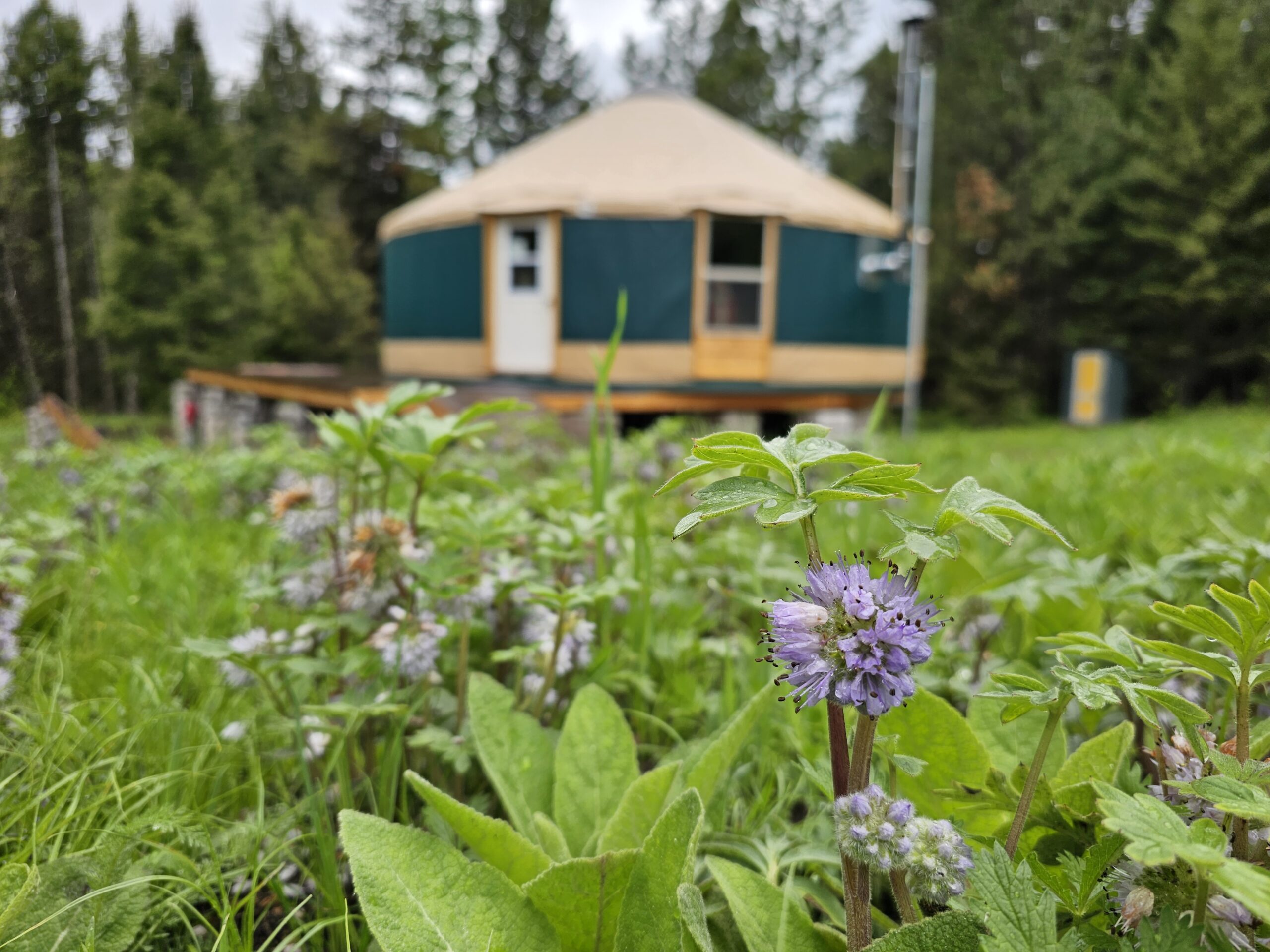
Ballhead Waterleaf (Hydrophyllum capitatum) is a perennial dicot (more on that below!) that loves moist forest clearings, thickets, and shaded slopes. She shows up early in the season, typically blooming May through July depending on elevation, and tends to hug the ground with her dense little flower clusters.
The genus name Hydrophyllum literally means “waterleaf” in Greek, a name that has stuck around as her common name too. The species capitatum refers to the head-like, ball-shaped flower clusters she is famous for. You might also hear her called woollen-breeches, which is a delightful name that comes from the fuzzy, coarse texture of her sepals and petals when she is still in bud.
Identifiers
Flowers: Light violet (sometimes whitish) – you can see both in the video – blooms in a dense, ball-like cluster. That is the “ballhead” part! The stamens extend well past the rim of the flower, giving her a slightly wild, fringed appearance. She typically blooms May to July.
Leaves: Pinnately lobed basal leaves that are larger than the flower clusters. The flowers often sit at or below the level of the leaves, or right at the ground surface in some varieties. The leaves can hold water droplets beautifully, which is where the waterleaf name comes from.
Stems: Short-stemmed and low-growing. She stays close to the ground and tends to prefer bare soil patches, forest openings, and moist slopes from the foothills up toward the upper tree line.
Size: Compact and ground-hugging. Don’t expect a big shrub. She is a humble, low-profile plant that rewards the curious observer who looks down.
Range: Canadian Rockies, British Columbia, and Alberta, south to central California, Utah, and Colorado. She is a western North American native.
Botany Breakdown
Classification: Dicot, Perennial. Traditionally placed in the Hydrophyllaceae family, though recent genetic research suggests she may belong with the borage family (Boraginaceae). This is actually still somewhat controversial since the two families differ significantly in fruit anatomy, so the debate continues!
Roots: Fibrous-rooted perennial. The fleshy-fibrous roots were historically gathered as food by Native Americans and early settlers.
Stems: Short, leafy stems. Some varieties produce flowers along the stem, while others put flowers right at ground level.
Leaves: Pinnately lobed, basal. Fuzzy and flannel-textured. The leaves are larger than the flower clusters.
Flowers: Bell-shaped, white to purple. Stamens extend well beyond the corolla rim. Clustered into a dense, ball-like head. Five petals, five sepals (sepals appear coarsely fuzzy in bud).
Fruits and Seeds: Fruit develops at or near ground level in some varieties. Seeds are distributed by ants, a process called myrmecochory, which is pretty fascinating! Flowers and fruits at ground level is often correlated with ant seed dispersal.
Edible Uses
According to Edible and Medicinal Plants of the West, Ballhead Waterleaf was an important early forage plant for American Indians. The leaves, stems, and flowers are all edible, but here’s the thing: she’s quite bitter raw. You can eat her fresh, but cooking will make her taste significantly better. The fuzziness of the leaves also makes raw consumption less pleasant, and heat takes care of that too.
Think of her as a spring green, a wild foraged vegetable for soups, sautés, or anywhere you’d use a cooked bitter green.
Herbal Actions
Waterleaf has an astringent quality, which is what drives her medicinal applications. The leaves can be applied topically as a poultice for minor wounds (as a protective field dressing), insect bites, and other minor skin irritations. This is gentle, accessible plant medicine, the kind you could use right in the field if you needed to.
Harvesting
Catch her early! She is a spring plant and the tender young shoots are the prime target. Leaves, stems, and flowers are all fair game. Cook before eating to reduce bitterness and that fuzzy texture. For a medicinal poultice, you can use the leaves fresh, just bruise or crush them and apply directly to the skin.
Meet Her IRL
Disclaimer: This blog post is for educational purposes only. Please consult a professional if you are planning to use Ballhead Waterleaf, or any herb, medicinally.


